
Trichoscopy
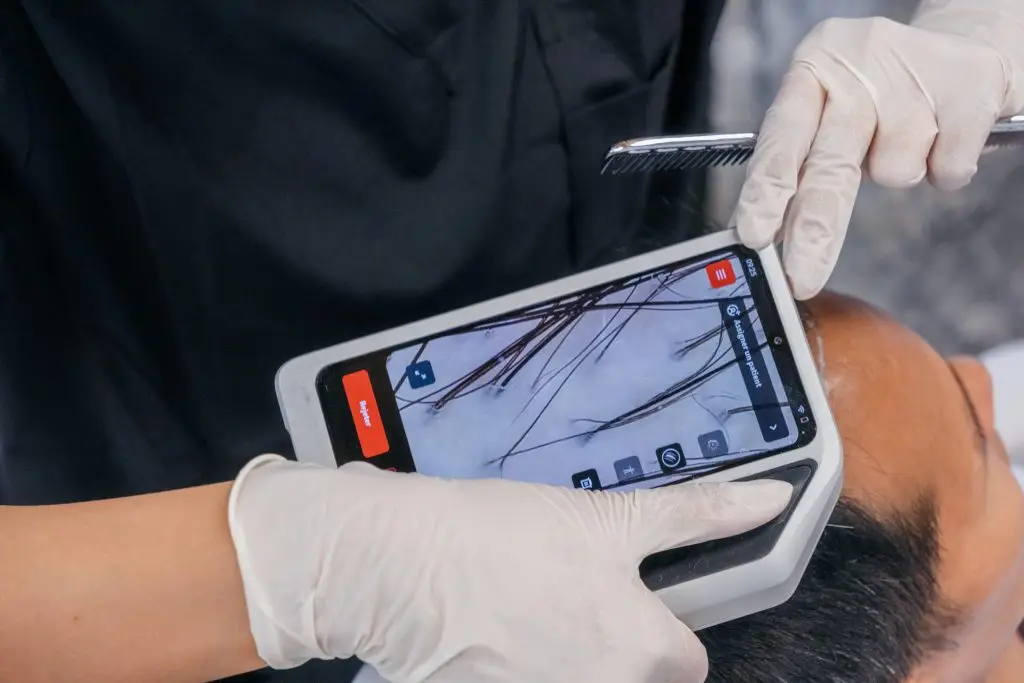
Trichoscopy, performed using the Fotofinder system—a global reference and leader in hair analysis—is a non-invasive medical examination that allows precise evaluation of the scalp and hair follicles. Through an optical magnification system combined with polarized light, it provides detailed and objective visualization of hair density, quality, and health.
At ANAGEN, trichoscopy is performed for every patient, before any hair transplant and then at each stage of post-operative follow-up.
It is an essential tool for evaluating, comparing, and documenting hair evolution over time, with a purely medical and measurable approach.
An Essential Examination in Hair Care Management
Trichoscopy is comparable to an “identity card” of the scalp.
It allows detailed observation of:
- the actual hair density (number of hairs per cm²),
- the proportion of miniaturized hairs,
- the vitality of the follicles,
- the quality of vascularization,
- and the condition of the donor and recipient areas.
This data allows for precise diagnosis, adaptation of the therapeutic strategy, and evaluation of the feasibility of a hair transplant.
Main Indications
Trichoscopy is indicated in all cases of hair loss:
- male or female androgenetic alopecia,
- diffuse or traction alopecia,
- reactive or postpartum hair loss,
- treatment monitoring (mesotherapy, PRP, medication),
- before and after hair transplant to analyze density and regrowth.
At ANAGEN, it is systematic before each transplant to establish the implantation plan and repeated at each follow-up to measure the objective evolution of the result.
The Advantages of Trichoscopy
1. Precise and Measurable Diagnosis
It allows for scientific quantification of hair density and the proportion of miniaturized hairs.
These measurements guide treatment selection and determine the ideal timing for a transplant.
2. Surgical Decision-Making Tool
Trichoscopy allows precise evaluation of:
- the capacity of the donor area,
- the number of available grafts,
- and the quality of the hair (thickness, caliber, orientation).
This information is essential for planning a realistic and secure transplant.
3. Post-Transplant Evolution Monitoring
At each follow-up (3, 6, and 12 months), trichoscopy is repeated to:
- observe the graft uptake,
- measure progressive regrowth,
- monitor the stability of the donor area,
- and compare the data with the initial images.
It is an objective way to visualize the patient’s actual progress, far beyond simple before/after photos.
4. Transparency and Medical Traceability
Each examination is documented and archived in the patient’s file.
These images serve as a medical reference for tracking evolution over time, adjusting treatments, and ensuring complete traceability of the result.
Examination Procedure
Trichoscopy is a quick, painless examination requiring no special preparation.
The scalp simply needs to be clean and dry.
Steps:
- Visual observation of the scalp and identification of key areas.
- Use of a magnifying medical camera with polarized light.
- Capture of high-definition images (frontal areas, crown, occipital region).
- Real-time analysis: density, diameter, follicle vitality.
- Medical report and explanation of results to the patient.
Average duration: 15 to 30 minutes.
The Value Before Hair Transplant
Before any transplant, trichoscopy allows for:
- evaluation of the quantity and quality of the donor area,
- determination of the number of available grafts,
- identification of any weakened areas,
- and definition of a precise implantation plan (density, direction, angles).
This step is essential to guarantee a natural result and preserve long-term scalp health.
The Value After Transplant
After the procedure, trichoscopy is used to:
- monitor healing and graft uptake,
- visualize regrowth at 3, 6, and 12 months,
- measure the density achieved and the quality of the new hair,
- adjust maintenance medical treatments if necessary.
It is an objective medical follow-up that allows the patient to see the biological results of their transplant concretely.
We answer all your questions
Do not hesitate to call us at 04 78 08 93 63 if your question is not in the list.
1. What is a hair transplant?
A hair transplant is a medical procedure that involves taking hair follicles from a donor area (often the back of the head) to reimplant them in thinning or balding areas.
Transplanted grafts retain their permanent character, allowing for definitive and natural regrowth.
2. What is the difference between FUE and FUT?
FUE (Follicular Unit Extraction) is a modern technique that allows grafts to be harvested one by one, without a visible linear scar.
FUT (Follicular Unit Transplantation), which is older, involves a surgical strip taken from the back of the head.
FUE is today the most used method for its precision and scar discretion.
3. Who is hair transplant for?
Hair transplant is intended for people suffering from androgenetic alopecia, mainly men between 25 and 60 years old.
A medical evaluation is necessary to check the density and quality of the donor area, as well as the stability of hair loss before considering an intervention.
4. How many grafts can be implanted in one session?
The number of grafts depends on the surface to be treated and the density of the donor area.
A session can range from 1,000 to 6,000 grafts, spread over one or two days depending on the clinical case.
The practitioner determines the most suitable strategy after the diagnosis.
5. Is the procedure painful?
FUE hair transplant is performed under local anesthesia.
The patient is conscious and relaxed throughout the procedure.
Discomfort may be felt after the intervention, but it disappears in a few days with the prescribed care.
6. When does transplanted hair grow back?
Regrowth follows several natural stages:
- Temporary loss of grafts between 2 and 4 weeks after the transplant,
- Start of regrowth around the 3rd or 4th month,
- Visible result at 6 months,
- Final result between 9 and 12 months after the intervention.
Each patient progresses at their own pace.
7. Does hair transplant leave scars?
The FUE technique leaves no linear scar.
Micro-traces may be visible on the donor area for the first few days, but they disappear quickly.
Good healing depends on following post-operative instructions.
8. Does transplanted hair fall out again?
Implanted hair comes from areas genetically programmed not to fall out.
They retain this characteristic after the transplant.
However, non-transplanted hair may continue to thin: regular medical follow-up helps stabilize the progression of baldness.
9. How long does a hair transplant session last?
The duration depends on the number of grafts to be implanted.
On average, a session lasts 6 to 8 hours.
For large transplants (up to 6,000 grafts), the intervention can be performed over two consecutive days.
10. What precautions should be taken after a hair transplant?
The first few days require specific care to protect the grafts:
- Gentle cleaning and thermal water spray,
- Avoid sun, sports, and wearing a cap,
- Sleep with the head slightly elevated,
- Follow the post-operative instructions given by the center.
Personalized follow-up is provided to accompany each stage of healing.